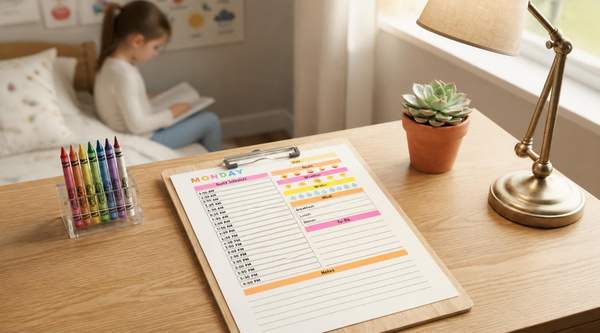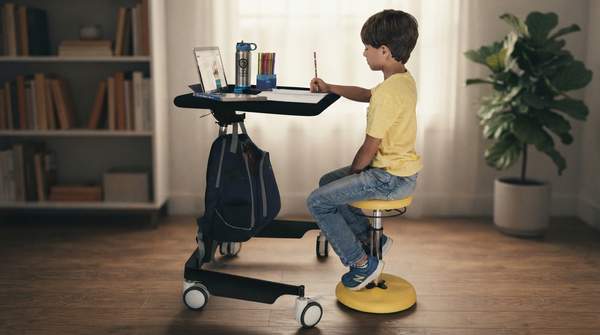
"Grow-with-me" children's furniture comes in two fundamentally different forms, and the right choice depends less on brand than on mechanism. Modular play couches adapt by being taken apart and rebuilt into forts, rockets and reading nooks; adjustable-height desks adapt by mechanically rising as your child does. This comparison walks through how each works, what certifications like CertiPUR-US and GREENGUARD Gold actually tell you, and ends with a decision framework you can apply to your own living room.
Modular vs. Adjustable: Two Paths to Grow-With-Me Furniture
The two categories solve the same problem—furniture that outlasts a single developmental stage—in opposite ways. A modular play couch is built from separate foam sections that come apart entirely, so the piece itself changes shape as your child's imagination changes. An adjustable desk keeps its form but changes its dimensions: the Brooklyn Desk from Oeuf, for instance, offers legs that extend to grow with your child, as described in the New York Post's children's furniture guide.
That distinction matters for durability and for daily life. A desk that adjusts is furniture first, and its growth is engineered into hardware. A play couch is furniture and toy at once, and its growth is open-ended: the same four foam pieces serve a toddler building a tower and an older child constructing a secret hideout. Neither is inherently better; they simply answer different family needs, which is why a structured comparison beats a brand list.
Modular Play Couches: Versatility for Creative Play
Play couches resemble modular adult couches that come apart, but for children they can be repurposed into whatever a child envisions—"from a rocket ship to a secret fort to a treehouse," as The Good Trade puts it in its roundup of nontoxic play couches. The Nugget, one widely known example, is made of four foam pieces offering what its maker describes as endless configurations, available in more than 15 colors and patterns with machine-washable covers.
The honest case for a play couch is frequency of use. SHAPPY, a play sofa maker, frames the value question bluntly: a play sofa is worth it if it will be used every week, does more than one job in the home, and is built for everyday play with a real warranty behind it. The company notes its own high-density foam and fabric carry a 3-year limited warranty against manufacturing defects, and that add-ons like arches, a slide and a rocker extend what children can build.
The downsides are equally concrete. Price is the first: a play couch costs more than a toy and more than a basic foam seat, so it only pays off with near-daily use. Space is the second—SHAPPY suggests that without room for roughly 120 × 60 cm plus surrounding build space, a play sofa will feel cramped. And tidiness is the third: on play days, your living room will be in pieces.
Adjustable-Height Furniture: Functional Adaptability for Tasks
Where the play couch adapts to imagination, the adjustable desk adapts to a body. The Brooklyn Desk's adjustable legs are designed to accommodate a child's physical growth, keeping the work surface ergonomically suitable for studying, drawing and reading across years rather than months. This is task-oriented adaptability: the furniture doesn't transform, but it tracks your child's height.
For families prioritizing schoolwork, crafts or reading, this mechanism has a quiet advantage—it stays where you put it. There are no foam pieces on the floor and no daily rebuilding, which is precisely the trade-off in reverse: you gain tidiness and focus, and give up open-ended creative play. Writing for WLLW, Lisa Sternfeld notes that modern children's design increasingly centers on healthy materials—avoiding formaldehyde, phthalates and lead, and favoring responsibly sourced solid wood with transparent material specifications and finishes chosen to minimize harmful emissions. That guidance applies directly when evaluating a wooden desk's paint, adhesives and finishes.
Prioritizing Safety: Key Certifications for Children's Furniture
Material safety is where play couches demand the most scrutiny, because foam is the whole product. Play couches are typically made of polyurethane, which The Good Trade notes is flammable and can contain harmful chemicals or VOCs (volatile organic compounds). That's the reason certification names matter more than marketing language like "nontoxic."
Two labels do specific work. CertiPUR-US certification applies to the foam itself, indicating it has been tested for harmful substances; The Good Trade identifies both the Nugget ($249 and up) and Figgy ($349 and up) as using CertiPUR-US certified foam. GREENGUARD Gold certification addresses emissions, and The Good Trade highlights one collection—the Soft Furniture line from House of Noa—as both GREENGUARD Gold and CertiPUR-US certified, "keeping your home's air cleaner and safer." For wooden adjustable furniture, the equivalent questions concern finishes and adhesives rather than foam, which is where Sternfeld's advice on transparent material specifications applies.
Decision Framework: Choosing Your Adaptable Children's Furniture
Use this matrix to map your family's priorities to the category that fits. Read each dimension, identify which column matches your home, and the column with more matches is your recommended category.
| Dimension | Modular Play Couch | Adjustable-Height Desk |
|---|---|---|
| Adaptability mechanism | Foam sections reconfigure into forts, rockets, seating | Adjustable legs raise the surface as the child grows |
| Primary use | Open-ended, imaginative play; doubles as seating | Task work: studying, drawing, reading |
| Material safety focus | Foam certification (CertiPUR-US); emissions (GREENGUARD Gold) | Wood, paint, adhesive and finish transparency |
| Aesthetic integration | Sits in the living room like normal furniture in calm fabrics—but in pieces on play days | Permanent, tidy presence in a study or bedroom |
| Space and tidiness | Needs ~120 × 60 cm plus build space; floor gets messy | Small footprint; stays assembled |
Three questions then confirm the choice. First, what will the furniture be for—daily creative play, or homework and focused tasks? Second, do you have the floor space and tolerance for a living room that's occasionally in pieces? Third, can you verify the material story—CertiPUR-US foam and GREENGUARD Gold for a couch, transparent finish specifications for a desk? If your answers lean toward play, space and mess-tolerance, the play couch wins; if they lean toward tasks, tidiness and a small footprint, the adjustable desk wins.
Making the Right Choice for Lasting Value
Choose adaptable children's furniture by prioritizing either dynamic, open-ended play (modular couches) or ergonomic, task-specific growth (adjustable desks), ensuring material safety certifications align with family values. The two mechanisms are not interchangeable, and the most expensive mistake is buying the wrong kind of adaptability, not the wrong brand.
How will you know it worked? The measurable indicator is this: the furniture piece is actively used by the child for its intended purpose (play or task) and continues to meet their developmental and physical needs over time, without showing premature wear or safety concerns. SHAPPY's own test is a useful benchmark—if the piece comes out once a month, it was the wrong buy; if it's used most days, the higher price of adaptable furniture pays for itself.
Sources
- The ultimate children’s furniture guide: 11 brands for safe, stylish and kid-friendly decor — New York Post
- 6 Best Play Couches With Nontoxic Materials (2026) — The Good Trade
- Is a play sofa worth it? Honest pros, cons and who it's not for — SHAPPY
- Designing for Growth: How Thoughtful Children's Furniture Shapes Devel — WLLW