Before you book a flight with your pet, the deciding question is simple: can your pet and a compliant carrier fit within the dimension and weight limits of the airline you want to fly? In-cabin rules vary noticeably between major US carriers, and a carrier that works on one airline may be rejected on another. By measuring your pet first and then comparing those measurements against each airline's maximum carrier dimensions, you can pre-qualify your options in minutes rather than calling customer service lines one by one. This guide walks through the in-cabin versus cargo distinction, a comparative table of major US airline limits, and how to measure your pet correctly.
Understanding In-Cabin vs. Cargo Pet Travel
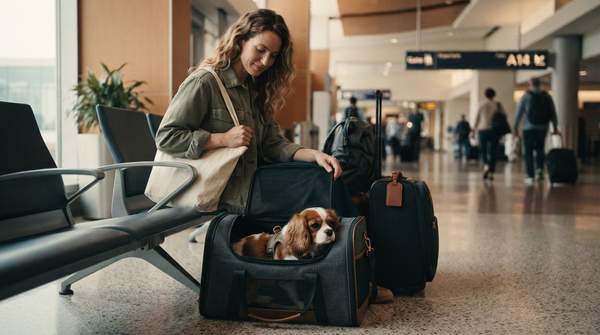
The first fork in pet air travel is placement. As pet product maker Coastal explains, an "in-cabin" pet is a domesticated cat or dog that fits in a carrier underneath the seat in front of you; pets that do not meet that definition may travel in the cargo section of the plane. That definition drives everything else, because the carrier requirements differ dramatically between the two placements.
In-cabin travel means the carrier must squeeze into a small under-seat space, which is why soft-sided carriers dominate that setting. Their flexible walls can compress slightly to fit tight spaces while still keeping the pet contained on your lap-adjacent floor area throughout the flight. Hard-sided carriers, by contrast, are built differently. Ridgefield Veterinary Center describes them as having a solid plastic shell and a sturdy metal door, with ventilation openings along the sides, giving pets a stable and secure enclosure. Because the structure is rigid and protective, Ridgefield notes, hard carriers are commonly used for car travel or when pets must fly in the cargo compartment.
There is one useful wrinkle: the soft-versus-hard split is not absolute. Southwest Airlines, for instance, permits carriers of either type in the cabin, provided they fit under a seat. So the carrier type follows the travel plan: soft-sided is the default for the cabin, hard-sided is the standard where stronger enclosure protection is needed, and the real constraint is the under-seat fit rather than the material itself.
It is worth setting expectations about enforcement, too. A frequent flyer blogger at Where's The Frenchie? reports that airlines do not always weigh pets at check-in, but that gate agents have weighed her dogs on several occasions and asked extra questions. In other words, even when a limit is loosely enforced, assuming it will not be applied is a gamble with a boarding pass at stake.