The Nintendo Switch 2 was built to leave the house, but the accessories you strap to it should depend on where you're going. Rather than chasing a generic "best of" list, the smarter move is to match accessory types to your dominant travel scenario: a short commute, a long-haul flight, or a group trip where multiplayer is the point. That's the framework below, built from what reviewers at BGR, Wirecutter, TechRadar, The Verge, and Techlicious have actually documented about the current accessory landscape.
Understanding Your Travel Style: Three Scenarios
Every travel kit begins with an honest diagnosis of your habits. BGR's Eduardo Ariedo frames the core problem plainly: the Switch 2's portability "comes with limitations, especially when spending a long time away from an outlet," and depending on what you play, "the battery can run out quickly, which can be a problem on longer trips." Charging, in other words, is the central variable that separates one traveler from another.
From there, three profiles emerge. The short-commute traveler moves in bursts—train rides, waiting rooms, a friend's couch—and needs protection and low bulk more than endurance. The long-haul traveler faces hours away from outlets and needs power above all. The group traveler carries the console as a social instrument, hauling controllers, game cards, and sometimes a dock so several people can play at once. Each profile prizes a different virtue: portability, power, or capacity.
Essential Protection: Choosing the Right Carrying Case
The case is the one accessory nearly every source treats as non-negotiable, but the category splits into meaningfully different tools. Ariedo warns that leaving the console loose in a backpack "can expose the screen and controllers to other objects and impacts," which is why a travel kit should start with a case.
At the minimalist end sits the slim shell. The Verge's Cameron Faulkner, who tested dozens of cases, highlights the Tomtoc FancyCase-G05 slim case at $25 as a low-bulk option, and notes that carrying cases need only "protect the console and, ideally, provide some extra value, like a pocket for cables, cartridge storage, or ideally both." Wirecutter's Haley Perry makes a related distinction with the Mumba Dockable Case ($24, for the original Switch and Switch OLED): a grip-style shell that protects the console "while you're actually holding it"—something roomier bags cannot do.
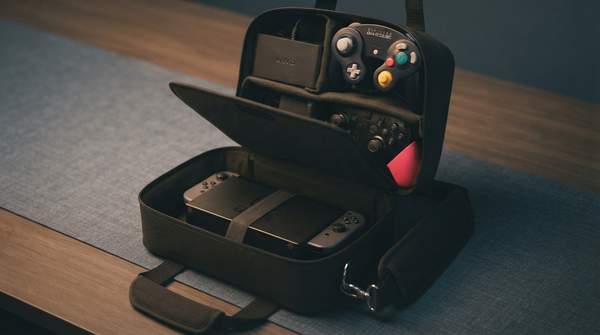
At the other end are all-in-one bags. TechRadar's Rhys Wood describes the Belkin Travel Bag as "smaller and lighter" than sturdier rivals but "surprisingly roomy," fitting the handheld, Joy-Con 2 controllers, a handful of games, and a charging cable. Techlicious's Rob Webb praises a sling-style carry case with "multiple compartments for your console, games, accessories, charger, and even a Pro Controller," water-resistant fabric, and an adjustable strap for commuting or heading to a friend's house.
Then there's the hybrid: Belkin's Charging Case Pro, listed by Faulkner at $85, builds a battery into the case itself. Vooks's Daniel Vuckovic records the premium pricing of Belkin's travel range—up to $149 for the integrated-battery case—while noting the simpler Belkin Protective Travel Case sits under $30. The trade-off is convenience versus cost and weight.
Powering Your Adventures: Portable Charging Solutions
For long-haul travelers, power is the kit's spine. BGR's guidance is that "having a backup is one way to keep enjoying games during the trip." Two accessory types answer that call. The first is a dedicated power bank: Wirecutter names the Genki Energy Pack its top pick, a magnetic pack that "can easily prolong your Switch's battery life by a few hours, without adding too much weight for handheld players."
The second is the integrated charging case, which trades the flexibility of a separate bank for an all-in-one object. The decision between them is the clearest trade-off in the whole kit: a separate power bank can top up other devices and be left behind when you don't need it, while a charging case means one less thing to remember—but you carry its weight and cost everywhere the console goes. Neither source quantifies wattage or capacity for these products, so treat the choice as structural rather than spec-driven.
Enhancing Multiplayer and Comfort: Controllers and Other Gear
Group travelers need the console to become a multiplayer machine. Webb highlights the Switch 2 Pro Controller for its adaptability "whether docked or in tabletop mode," bringing "a premium console feel to this handheld hybrid" across genres from RPGs to racing games. That tabletop capability is what turns a single console into a party—provided you have controllers to share and a case roomy enough to carry them.
This is where the all-in-one bag earns its keep: compartments sized for a Pro Controller, charger, and game cards mean the whole group setup travels as one unit. Wood's testing of the PlayTrek Travel Case found it "plenty of space for your Switch 2 handheld and plenty of games," with a sturdy exterior and well-cushioned interior, though "a bit bulky compared to Nintendo's official option." Bulk, again, is the price of capacity.
Your Personalized Switch 2 Travel Kit Decision Framework
The matrix below maps each scenario to its accessory priorities and the trade-off you accept. Read your own habits down the first column; the recommended kit follows from the scenario's core constraint.
| Travel scenario | Core constraint | Recommended accessory types | Trade-off you accept |
|---|---|---|---|
| Short commute / day trip | Bulk is the enemy; sessions are brief | Slim protective shell or small travel case, plus a screen protector | Minimal carrying capacity—no room for a full controller or charger loadout |
| Long-haul flight / solo travel | Hours away from an outlet | High-capacity power bank (e.g., a magnetic pack like the Genki Energy Pack) or an integrated charging case | Added weight and cost; a charging case carries its battery even on short trips |
| Group trip / multiplayer focus | Shared play in tabletop or docked mode | All-in-one travel bag with multiple compartments, plus a Pro Controller | Bulk—a roomy, padded case is heavier and less pocketable than a slim shell |
The framework's logic is simple: each scenario's constraint dictates one dominant accessory type, and the other categories flex around it. A commuter's slim case sacrifices storage; a long-hauler's power solution sacrifices weight; a group kit sacrifices pocketability. No single product escapes all three prices at once.
Build Your Ultimate Switch 2 Travel Kit
Readers should select their Nintendo Switch 2 travel accessories by first identifying their most frequent travel scenario—Short Commute, Long Haul, or Group Travel—and then prioritizing accessory types that align with that scenario's core needs for portability, power, or multiplayer support. The measurable indicator of success: you have identified a primary travel scenario and a corresponding set of essential accessory types, along with an understanding of the trade-offs involved in your choices.
In practice, that means one honest question before any purchase: where do I actually play away from home? If the answer is a backpack on a train, a $25-class slim case and screen protector are the whole kit. If it's a six-hour flight, budget for power first—the Genki Energy Pack Wirecutter recommends or Belkin's $85 Charging Case Pro. If it's game night at a friend's house, invest in capacity: a multi-compartment travel bag and a Pro Controller. The sources here document types and prices, not tested rankings, so let your scenario—not a leaderboard—spend your money.
Sources
- Everything You Should Have In Your Nintendo Switch 2 Travel Kit - BGR
- The Best Nintendo Switch 2 and Nintendo Switch Accessories — Wirecutter: Reviews for the Real World
- The best Nintendo Switch 2 accessories: controllers, screen protectors, and carry cases you can't do without — TechRadar
- I tested dozens of cases for the Switch 2 and these are the best — The Verge
- Your Nintendo Switch 2 launch kit: The best accessories — Techlicious
- The Vooks Guide to the Best Nintendo Switch 2 Accessories - Vooks