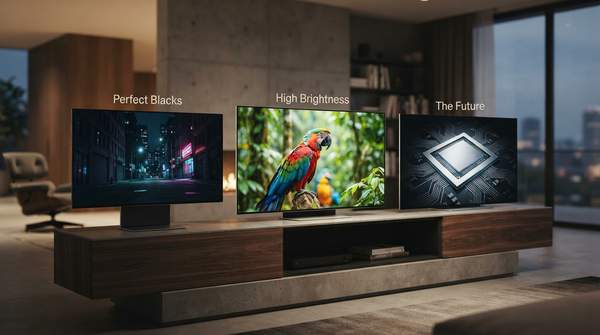
The shortest answer to the smart-device display question: no single panel technology wins. OLED delivers the deepest, per-pixel blacks and the most immersive dark-room picture, Mini-LED wins raw brightness for well-lit rooms and HDR, and MicroLED promises OLED-class contrast with inorganic durability — at a cost and availability that still keep it out of most consumers' hands. The right choice depends less on which is "best" and more on where you watch, what you watch, and how long you plan to keep the device.
Understanding Premium Display Technologies: OLED, Mini-LED, and MicroLED
Today's premium displays split into two families. Self-emissive technologies — OLED and MicroLED — generate light at every individual pixel. Backlit LCD technologies use a separate light source shining through a panel; Mini-LED is the advanced version of this approach, replacing a handful of large backlight LEDs with thousands of tiny inorganic diodes organized into dimmable zones. The industry, as described in a comparative analysis from patent-analytics firm Patsnap Eureka, is chasing the same goals across all three: higher energy efficiency, longer operational lifespan, better brightness and color accuracy, and lower production costs.
The distinction matters because it drives everything else. A pixel that can switch itself fully off produces fundamentally different black levels than a lit zone that merely dims behind a dark area. That single architectural difference explains most of the trade-offs in picture quality, longevity, and power behavior that follow.
OLED: Perfect Blacks and Immersive Contrast
OLED stands for organic light-emitting diode, and the operative word is "organic." Each pixel is its own light source, emitting both light and color directly, with no backlight involved. Because a pixel can be turned off completely, a black area of the screen emits nothing at all — true zero, which is why OLED is consistently described as producing perfect blacks and effectively infinite contrast. Samsung positions its OLED televisions around exactly this strength: "deep black levels and balanced whites," with pixels "controlling one by one," creating what the company calls a striking combination of depth and clarity.
That organic chemistry has a cost, though. The same Patsnap Eureka analysis notes that OLED technology "continues to struggle with limited lifespan issues, particularly with blue OLED materials degrading faster than red and green counterparts, resulting in color shift over time." Burn-in — permanent image retention from static elements — "remains a persistent challenge," especially in applications with fixed interfaces. Mitigating these problems requires complex compensation algorithms that add manufacturing complexity and cost. Peak brightness is also generally lower than Mini-LED's, which is the trade-off you accept for those perfect blacks.
Mini-LED: Brightness and Enhanced Backlighting
Mini-LED is not a new panel type; it is a dramatically better backlight for an LCD. Instead of a handful of large LEDs, a Mini-LED display packs thousands of tiny inorganic LEDs behind the LCD, grouped into local dimming zones. Each zone dims independently based on the content behind it. As CNET's Geoffrey Morrison explains, "the LEDs behind dark areas of the image are dimmed so that area is darker," and "with enough zones, this is harder to notice, but it can still be visible" — the lit zones don't precisely match the outline of bright objects on dark backgrounds.
That limitation is called blooming, and it is the structural ceiling on Mini-LED contrast. The zones can dim, but they cannot turn off per-pixel, so blacks are enhanced rather than perfect — a distinction most visible in high-contrast scenes. What Mini-LED gives back, however, is serious brightness: display-industry comparisons report that premium Mini-LED televisions routinely hit around 2,000 nits peak brightness, which makes HDR highlights pop and keeps the picture watchable in bright, sunlit rooms where OLED can struggle.
Longevity is Mini-LED's quiet advantage. Its inorganic LED backlight is not subject to the organic material degradation affecting OLED, and a well-manufactured Mini-LED display is rated for roughly 60,000–100,000 hours — a decade or more of typical use — with no risk of permanent image retention from static content.
MicroLED: The Future of Display Technology
MicroLED takes OLED's core idea — every pixel emits its own light — but swaps the organic compounds for microscopic inorganic LEDs. In principle, this combines OLED's per-pixel contrast with the durability of inorganic materials: no burn-in risk, and a longer operational lifespan than organic panels can offer. It is a genuine best-of-both-worlds architecture, and it is also the least mature of the three. Sony demonstrated the first commercial MicroLED display, the Crystal LED, back in 2012, at a cost Patsnap Eureka describes as prohibitive for mass-market adoption — a signal, the analysis notes, of the ongoing difficulty of scaling production efficiently, since each microscopic inorganic LED must be manufactured and transferred onto a panel with extreme precision.
The result is that MicroLED today is a premium, limited-availability technology rather than a mainstream option, found in ultra-high-end commercial displays rather than consumer televisions or phones. Its per-pixel, self-emissive design is particularly compelling for near-eye applications — the category where image imperfections are most visible — which is where its near-term promise concentrates.
Display Technology Comparison: OLED vs. Mini-LED vs. MicroLED
The table below contrasts the three technologies across a consistent set of criteria drawn from manufacturer guidance, technical analyses, and industry comparisons. Reading it side by side makes the verdict visible: each technology dominates in a different column, which is exactly why no single one wins overall.
| Attribute | OLED | Mini-LED | MicroLED |
|---|---|---|---|
| Core Mechanism | Self-emissive organic pixels; each generates its own light and color | LCD panel backlit by thousands of tiny inorganic LEDs in local dimming zones | Self-emissive microscopic inorganic LEDs; each pixel emits its own light |
| Contrast & Black Levels | Perfect blacks — pixels switch off entirely, for effectively infinite contrast | Deeper blacks than traditional LED, but zones cannot fully block light; blooming possible around bright objects | Per-pixel, self-emissive contrast comparable to OLED's perfect blacks |
| Peak Brightness | Generally lower peak brightness than Mini-LED; ample for most indoor viewing | Very high — premium models routinely reach about 2,000 nits | Well-suited to high-luminance HDR per industry analyses, with consumer benchmarks still emerging |
| Longevity & Burn-in Risk | Burn-in persists as a challenge with static content; blue OLED material degrades faster, causing color shift over time | No burn-in risk; rated roughly 60,000–100,000 hours | Inorganic materials mean no burn-in risk and a longer lifespan than OLED |
| Power Efficiency | Efficient with dark content, since off pixels draw no light | High backlight output costs energy, offset by zone dimming | Designed for high efficiency, but comparable consumer efficiency data is still limited |
| Best Use Case | Dark-room movie watching and high-contrast content | Bright rooms, sports, and daylight viewing | Near-eye VR/AR applications where per-pixel contrast matters most |
One pattern worth naming: the table's rows trade off against each other by design. OLED's organic pixels buy perfect blacks but concede lifespan; Mini-LED's inorganic backlight buys longevity and brightness but concedes per-pixel contrast; MicroLED resolves both but concedes on cost and availability. Marketing labels can obscure this — Mini-LED panels appear inside Samsung's "Neo QLED" televisions, for instance — so the panel architecture, not the brand line, is what determines what you see on screen.
Matching Technology to Use Case
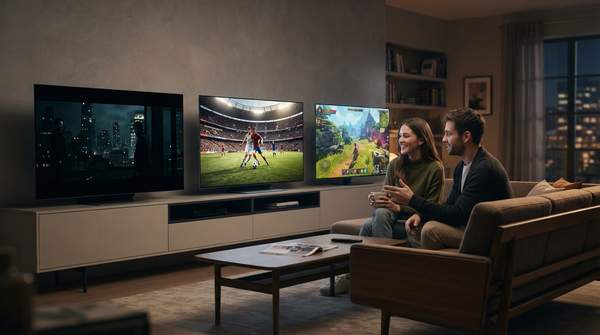
For dark-room movie watching, OLED is the natural pick. Its per-pixel black expression rewards cinematic, high-contrast content, and its generally lower peak brightness is a non-issue in controlled lighting. For bright rooms and general family use — daytime sports, sunlit living rooms, kitchen TVs — Mini-LED's advantage is decisive: around 2,000 nits of peak brightness keeps HDR highlights vivid and the picture legible where an OLED would look washed out, and its 60,000–100,000-hour, burn-in-free rating suits households that leave static menus or channel logos on screen for long stretches.
For near-eye VR and AR, the calculus changes again. As display-industry comparisons observe, "in a VR headset, imperfect blacks are immediately visible and immersion-breaking in a way that watching a TV across the room is not." That is why the premium VR market — devices such as Apple Vision Pro, Bigscreen Beyond, and Pimax Crystal Super — has converged on Micro OLED rather than any LCD variant, including Mini-LED. Per-pixel self-emission, not raw brightness, is the quality that matters inches from your eyes, which is also why MicroLED's architecture is so promising for this category.
Making Your Choice: The Right Display for Your Device
Choose OLED for unparalleled contrast and dark-room performance, Mini-LED for superior brightness in well-lit environments, or consider MicroLED for future-proof devices prioritizing longevity and efficiency — especially in VR/AR. MicroLED remains a long-term bet rather than a shelf option today: its 2012 debut's prohibitive cost still reflects real manufacturing complexity, so unless near-eye displays are the target, OLED and Mini-LED are the practical decision. The measurable indicator of a correct choice is your satisfaction with visual quality and battery life in your primary use case: a movie lover in a dim den should be happiest with OLED's perfect blacks, while a bright-room viewer should find Mini-LED's HDR punch — visible in that ~2,000-nit figure — the difference they notice every day.