The short answer: standard packing cubes exist to keep you organized, while compression cubes — the ones with a second zipper that cinches the bundle tighter — exist to shrink bulky clothing. Choose standard cubes when your problem is finding socks without unpacking the whole bag; choose compression when your problem is fitting a week of sweaters into a carry-on. Many travelers, including writers who resisted compression cubes for years, end up using both. Here is how to decide, and how to pack each type well.
Understanding Packing Cubes: Standard vs. Compression
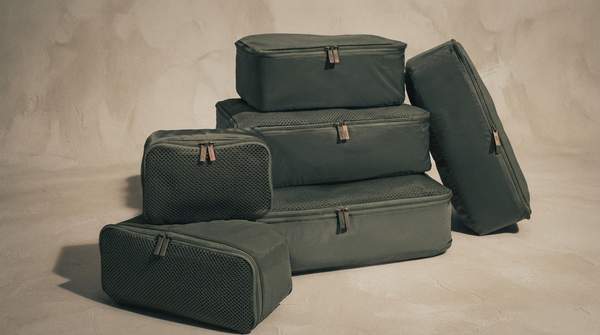
As luggage-maker Eagle Creek's guide puts it, a regular packing cube contains and organizes belongings. Think of each cube as a drawer you can lift out of the suitcase: jeans in one, sweaters in another, socks and underwear in a third. The cube itself does nothing to shrink your clothes — its value is tidiness and, because the cubes stack neatly, efficient use of vertical space in the bag.
A compression cube adds a second zipper around a gusseted panel. Zip the main closure first, then pull the second zipper and the packed bundle draws tighter, squeezing out excess air trapped in knitwear and fleece. Brand Sauce's buyer's guide makes the underlying physics plain: a compression cube makes clothing take up less space; it does not make it lighter. That distinction matters — your suitcase's weight limit is untouched, even when its volume problem is solved.
Decision Framework: Choosing the Right Cube for Your Trip
The right choice follows from two questions: what are you packing, and what is your priority? Bulky, air-trapping items reward compression; varied, small items reward organization. The framework below maps common scenarios to the tool that suits them.
| Dimension | Standard Packing Cubes | Compression Packing Cubes |
|---|---|---|
| Primary function | Organize and categorize items so each garment type has its own container | Reduce clothing volume by squeezing out excess air via a second zipper |
| Best use case | Travelers who mainly want to find items fast and separate outfits — think "filing folders" for clothes | Bulky items like sweaters, down jackets and jeans when space, not tidiness, is the constraint |
| Space-saving potential | Indirect: neat bundles and stacking use vertical luggage space well, but nothing is actively compressed | Actively flattens the bundle; slim, malleable results can be tucked into gaps in an already full bag |
| Typical clothing types | Undergarments, socks, tops, bottoms — anything you sort rather than shrink | Loose, air-trapping items — socks and underwear, knitwear, insulated outerwear |
| Both types | Both cord off contents, keep clean separated from dirty laundry, and shield the rest of the bag from muddy shoes | |
One caution from Brand Sauce's guidance: a cube that looks impressively flat in a product photo may still not fit your actual bag or your actual trip clothing, and a badly chosen compression cube can force an awkward repacking routine. Test with your real garments, not the photo.
Mastering Packing Techniques: Rolling, Folding, and Compressing
How you place clothes inside the cube depends on the cube and the garment. Eagle Creek frames it as a question of temperament — are you a clothes roller or a clothes folder? — but the answer really follows the fabric. Rolling suits casual wear: t-shirts, jeans, and knitwear can be rolled tightly and slotted together, and rolling complements compression cubes especially well, because a cube full of rolls compresses evenly without hard creases.
Folding suits structured garments — dress shirts, tailored trousers — because it keeps creases along natural seams. Eagle Creek's advice is to assess what you have and choose the cube and method "fit for the task," which in practice means combining both: fold the formal shirt, roll the t-shirts around it, and let the compression zipper handle the bulky sweater. Avoid the temptation to overstuff; a compression cube works by expelling air, and a bundle crammed past its main zipper's capacity will fight the second zipper rather than compress cleanly.
Strategic Organization: Building a Cohesive Luggage System
Individual cubes only pay off as a system. Marie Kondo's approach, quoted by Condé Nast Traveler, starts before you pack: lay everything out and categorize by type so you can see exactly how much you have — undergarments, tops, bottoms, shoes, toiletries, accessories — then assign one cube per category.
Two further systems work for different trips. Category packing (all tops in one cube, all bottoms in another) makes it easy to pull clean clothes mid-trip without disturbing the rest. Outfit-based packing — one cube per day or per occasion — suits tightly scheduled travel where you want to grab and go. Whichever you choose, reserve one cube as the laundry bag: the same container that keeps clean shirts pristine on departure collects the dirty ones on the way home, and shoes stay in their own compartment so mud never meets fabric.
Beyond the Basics: Maximizing Your Packing Cube Benefits
Eagle Creek suggests a set of at least three different sizes — a Goldilocks approach where, whatever you're packing, one cube is "just right," whether that's a single down jacket or four pairs of boardshorts. Sizing also disciplines the packing list: when most of your belongings must slot into specific containers, it becomes obvious which items won't fit, and the temptation to overpack shrinks with them.
On compression, keep expectations calibrated. An Outside writer who finally bought compression cubes after years of skepticism found them "particularly helpful for clothes, especially loose items like socks and underwear, which can be condensed into a much tighter space." But even enthusiasts note that the flattest bundle still has to fit somewhere, and one Condé Nast editor prizes compression cubes as much for their flexibility — compressive when wanted, forgiving when a cube needs to sit half-empty — as for raw volume savings.
Your Next Step: Pack Smarter, Travel Lighter
Choose your strategy — standard cubes for organization, compression cubes for bulky garments and maximum space, or a mix of both — based on your actual clothing list and priority, then pack with the matching technique: rolls for casual wear and compression, folds for structured pieces, one cube per category or outfit, and a dedicated cube for dirty laundry. The measurable indicator that you got it right is concrete: reduced luggage volume, easier access to items without unpacking the whole bag, and a suitcase that stays organized for the entire trip.
Sources
- How To Use Packing Cubes: Folding, Packing & More! — Eagle Creek
- Branded packing cubes: is compression worth the extra zipper? — Brand Sauce
- The Most Effective Way to Use Packing Cubes, According to Expert Organizers — Condé Nast Traveler
- The Piece of Luggage I'll Never Travel Without Again — Outside