The right headlamp is the one whose brightness, beam pattern, and battery system match the specific demands of your primary nighttime activity. A lamp that is excellent for reading in a tent is nearly useless for running a dark trail, and vice versa. This guide explains the three core technical features and then maps them to common activities—camping, night hiking, and trail running—so you can translate your intended use directly into a specification profile before you buy.
Understanding Lumens: Brightness and Range
Lumens measure total light output, and the amount you need scales with how far ahead you must see and how fast you are moving. For low-demand scenarios, a low-brightness setting provides soft, non-glare lighting, consumes minimal power, and supports ultra-long standby time, according to a 2026 headlamp buying guide. The same guide identifies 200 to 350 lumens as the most popular and balanced range for standard camping, short-distance night hiking, and casual night fishing, offering clear medium-range illumination without excessive power loss.
For more demanding use—long-distance night trekking, mountain climbing, wilderness exploration, and cross-country night running—that guide recommends 400 to 800 lumens. Crescent Moon Gear offers a compatible framing for hiking specifically: under 100 lumens suits map reading, camp chores, or emergency backup; 100–200 lumens handles general hiking on well-marked trails and around camp; and 200-plus lumens is ideal for off-trail hiking, rugged terrain, or fast-paced hiking where spotting obstacles is crucial. For night hiking in particular, the retailer calls 200–300 lumens essential to see clearly in the dark, while 100–150 may suffice for daytime map reading or shaded areas.
Beam Patterns Explained: Spot vs. Flood
Headlamps with multiple light settings generally offer two types of lighting: flood and long-throw, and some combine the two. Floodlighting provides a wide beam over a shorter range, useful for general camp tasks, up-close repair work, and reading. As the reviewers at iRunFar note, the human eye sees in roughly a 100-degree cone in front of the face, and most floodlighting illuminates that area.
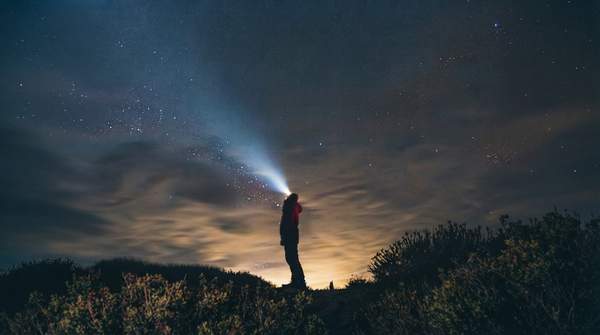
Long-throw light, also called a spotlight, casts a narrower beam farther out in front of you, lighting up the trail ahead at the expense of peripheral vision. It is the most common type of lighting used on the trail. The practical rule from Crescent Moon Gear: use a shorter beam distance when looking at objects close up, such as around camp, and a longer beam distance when you are on a trail trying to see objects far away. Some lamps let you move smoothly between flood and spot—for example, via a focus lever—so you can adapt without fumbling in the dark.
Battery Management Systems: Powering Your Adventure
Battery choice shapes both run time and how the light behaves as power drains. One key distinction is regulated output: rather than gradually dimming as batteries drain, regulated headlamps hold a steady brightness level throughout the batteries' life. REI's expert advice calls this a deservedly popular feature, but flags the downside—when the batteries are exhausted, a regulated lamp can go dark abruptly, potentially leaving you scrambling to replace batteries in the dark.
Burst or boost modes illustrate the brightness-versus-drain tension in miniature. An extra-intense beam projected for a brief period—perhaps 10 to 20 seconds—is useful for checking what is causing a rustling sound nearby, but REI cautions that this mode exerts a high drain on batteries. Run time also collapses at maximum output: iRunFar's testing found that one lamp's brightest 600-lumen setting would not last more than a couple of hours, making it insufficient to power a runner through a full night in an ultramarathon. Buyers comparing rechargeable and disposable batteries should weigh that trade-off against trip length and access to charging.
Headlamp Selection Framework: Activity to Features
The framework below maps each common activity to a recommended technical profile. It works by reading your primary activity down the first column, then checking the lumen range, beam pattern, and considerations that define a suitable lamp. The lumen figures synthesize the ranges above; the beam and consideration columns reflect how each activity's pace and environment change what matters.
| Outdoor Activity | Recommended Lumens | Primary Beam Pattern | Key Considerations |
|---|---|---|---|
| Close-range tasks (camping, reading, camp chores) | Low output, often under 100–200 lumens | Flood — broad cone over a short distance | Soft, non-glare light with minimal power consumption for long standby; a wide wash can even substitute for a lantern in a tent |
| Standard camping / short night hiking | 200–350 lumens | Flood with some throw for medium range | Balanced range offering clear medium-range illumination and stable battery life for a full night |
| Night hiking / trail navigating | 200–300 lumens essential; 200+ for rugged or off-trail terrain | Long-throw (spot) for seeing objects far ahead | Seeing clearly in the dark is crucial; a tilting head lets you place the beam exactly where needed |
| Fast-paced trail running | High output — around 600 lumens for dark trails; 100 may do with streetlights | Spot that reads the ground ahead | Stability and comfort matter as much as brightness; a bouncing or heavy lamp ruins a run, and top output may last only a couple of hours |
| Climbing and adventure use | Within the 400–800 lumen high-output band for demanding terrain | Depends on environment and pace | Choose by matching the lamp to the specific environment, pace, and duration of your sessions |
Two boundaries apply to this framework. It covers common outdoor recreational use, not professional, industrial, or tactical applications. And it deliberately recommends specifications rather than specific brands or models—water resistance and other durability features are worth checking, but they sit outside this decision matrix.
Key Trade-offs: Balancing Features for Optimal Performance
More power is not automatically better, because every feature competes with another. The clearest trade-off is brightness versus run time: higher lumen settings drain batteries dramatically faster, as the two-hour limit at 600 lumens shows, so a lamp that is excellent for a fast evening run may be inadequate for an overnight trip. Weight is the second axis. CleverHiker's analysts found a 3.8-ounce flood-and-spot lamp delightful for camp use and hiking, but explicitly not recommended for trail running or any high-output activity where bounce is a factor.
For runners, Trail & Kale's reviewer Alastair Dixon argues the priorities outright: what matters more than raw output is "how stable it feels when you're moving, whether the beam actually helps you read the ground ahead, and whether it stays comfortable enough that you stop thinking about it once the run gets going." Most runners, he notes, do not need a huge, overbuilt light—a lightweight lamp with a secure fit, useful beam pattern, and dependable battery life is the sweet spot. Finally, weigh rechargeable convenience against disposable-battery flexibility for multi-day trips, and remember that regulated output buys steady brightness at the cost of an abrupt, rather than gradual, shutdown.
Your Next Step: Confidently Choosing Your Headlamp
Select a headlamp by prioritizing lumen output, beam pattern, and battery features that directly align with the specific demands and duration of your primary nighttime outdoor activity. Start from your activity, read its row in the framework, and treat any candidate lamp's spec sheet as a checklist against that profile. The measurable indicator of a good choice is simple: the chosen headlamp's specifications (lumens, beam type, battery life) match the recommended profile for the intended activity, as outlined in the decision framework. If a 600-lumen running lamp's top setting lasts only a couple of hours and your run is longer, that mismatch—not the price or the brand—is what should send you back to the shelf.
Sources
- How to Choose an Outdoor Headlamp: Lumens, IP Rating, Battery Type & Beam Mode Explained — Investor
- Choosing the Right Headlamp for Hiking: How Many Lumens Do You Need? — Crescent Moon Gear
- Best Running Headlamps of 2026 — iRunFar
- How to Choose an LED Headlamp — REI
- Best Headlamps of 2026, Tested & Reviewed — CleverHiker
- Best Running Headlamps right now: Bounce-Free Visibility — Trail & Kale