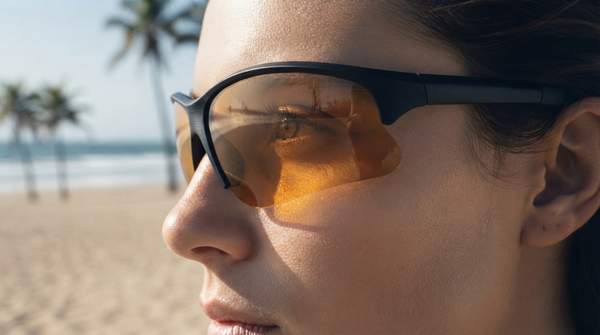
The single non-negotiable feature in any pair of sunglasses is a label reading "100% UV protection" or "UV400." Everything else — lens material, polarization, mirror coatings, tint darkness — is a matter of comfort, performance, or durability, not safety. The U.S. Food and Drug Administration and the American Academy of Ophthalmology both direct buyers to look for that full-protection label, which covers both UVA and UVB radiation. Once that box is checked, the real decision becomes choosing a lens material whose trade-offs match how you actually live: polycarbonate for impact-heavy sports, glass for maximum clarity in gentler everyday use.
Lens Material Showdown: Polycarbonate vs. Glass
Most nonprescription sunglass lenses are made from some type of plastic, and among plastics, polycarbonate is the standout for active use. The American Academy of Ophthalmology notes that polycarbonate sunglasses can withstand stronger impacts than regular plastic lenses, which is why the material is so often recommended for sports. Its toughness is quantifiable: according to DSRT Standard, a maker of ANSI-certified eyewear, polycarbonate carries a ballistic shatter resistance rating above 2.2mm — higher than nylon, standard plastic, or glass — and it is the material that allows a lens to meet ANSI Z87.1 impact standards while staying light enough for all-day wear.
Polycarbonate's weaknesses are the flip side of its strengths. Uncoated polycarbonate lenses tend to scratch easily, so the Academy of Ophthalmology advises buyers to make sure a scratch-resistant coating is included. On clarity, REI's expert buying guide rates polycarbonate as offering excellent impact resistance and "very good" optical clarity — good, but not the best available. In exchange, you get a lens that is affordable, lightweight, and low-bulk.
Glass occupies the opposite corner of the trade-off space. REI's guide describes glass as offering superior optical clarity and superior scratch resistance — the highest visual quality of the common materials, with no coating needed to keep it that way. But glass is heavier than other materials and more expensive, and it behaves differently under impact: rather than chipping or shattering like regular plastic, glass will "spider" — crack in a spreading web pattern — when struck. That makes it a poor match for fast-moving balls, trail debris, or any activity where a lens is likely to take a hit.
One caution applies to both materials, and to every other lens on the shelf: darkness is not protection. The Academy of Ophthalmology warns shoppers not to assume that the darker the lens, the more it will protect their eyes — only sunglasses with 100% UV protection provide the safety you need. A dark lens without UV filtering can be worse than no sunglasses at all, because it prompts your pupils to dilate behind inadequate filtering.