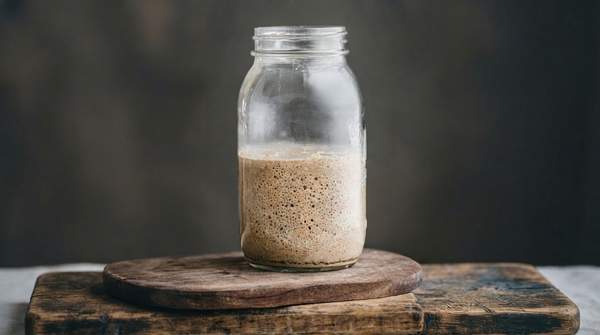
A sourdough starter is not an ingredient so much as a settlement: a mature mixture of flour and water hosting an established community of wild yeasts and lactic acid bacteria that live in a stable, mutually beneficial partnership. Understanding that partnership—and the two levers that steer it, temperature and feeding ratio—turns starter maintenance from superstition into management. This guide explains the science behind fermentation and closes with a diagnostic framework for troubleshooting. It covers starter maintenance only, for standard wheat-flour starters; it is not a bread recipe, and results may vary with rye or gluten-free flours.
The Microbial Symphony: Yeast and Bacteria in Sourdough
As Purdue University's College of Agriculture explains, sourdough results from wild fermentation involving Lactobacillus species (lactic acid bacteria) and Saccharomyces cerevisiae (a yeast), both naturally present in flour and water. When the two are mixed, the paste becomes an ideal environment for microorganisms to grow and interact. Purdue describes this as a symbiotic relationship essential to sourdough production—the reason starters can be maintained for long periods is precisely that the community is stable and self-reinforcing. A starter, in Purdue's framing, is simply a mature mixture containing an established, beneficial group of bacteria and yeast.
The division of labor is what makes the system work. The yeast produces carbon dioxide, which leavens the dough and makes it rise. The lactic acid bacteria produce lactic and acetic acids, which give sourdough its tangy flavor and act as natural preservatives. Research on lactic acid bacteria proportions in sourdough notes that both acids lower the pH of the dough, creating an environment less favorable for the growth of spoilage microorganisms and fungi. The bacteria, in other words, both flavor the bread and guard it—an ancient arrangement in which the yeast's gas and the bacteria's acid each make the environment better for the loaf and less hospitable to everything else.
The balance between the two acids matters as much as their presence. That same research emphasizes that achieving the right ratio involves controlling fermentation conditions—time and temperature—and using a balanced starter culture, which may include both homofermentative and heterofermentative lactic acid bacteria in appropriate proportions. Managing the fermentation process to optimize lactic and acetic acid concentrations, the researchers write, is crucial for enhancing the bread's sensory attributes and inhibiting fungal growth on its surface. The baker is not feeding a pet so much as tuning an ecosystem.
Influencing Flavor and Activity: Temperature and Feeding Ratios
Temperature is the first lever, and it acts on the bacteria directly. According to Bakery Academy, most lactic acid bacteria, such as Lactobacillus species, grow best between 20°C and 30°C, and some species like L. sanfranciscensis can remain active at temperatures up to 36°C. Because temperature has a significant impact on the growth of various bacteria in sourdough, it in turn affects fermentation and the final flavor of the bread. A warmer spot on the counter means faster fermentation; a cooler one slows the whole engine down.
A scientific review of sourdough starters, practices, and sensory quality reinforces this picture from the research side. It points to fermentation temperature, feeding protocol, and hydration as the very parameters bakers manipulate, and notes some evidence that hydration affects the profile of volatile organic compounds in starters. The review also flags an honest gap: more sensory research is needed to identify which of these practices makes the largest impact on flavor, texture, and color. So treat temperature and hydration as reliable levers, not dials with guaranteed markings.
Hydration is the second lever, and it works on flavor most directly. Cultures for Health explains that sourdough cultures produce two main acids: lactic acid and acetic acid, the vinegar-like acid that gives sourdough much of its tang. Acetic acid is produced more abundantly in a drier environment, while lactic-acid-producing organisms seem to thrive in a wet one. Maintaining a starter at lower hydration—a higher ratio of flour to water—therefore favors the sharper, vinegary tang; a wetter starter favors the softer, yogurt-like acidity of lactic acid. Whole-grain flours, the same source adds, are loved by the acid-producing bacteria.
Hunger changes the equation too. A starter left unfed develops hooch, the brown liquid layer on its surface, and Cultures for Health recommends keeping that hooch instead of pouring it off when you want more tang, since retaining it adds acidity. Regular feeding does the opposite: it keeps the yeast supplied with fresh food and the culture balanced. Neglect shifts the balance toward the bacteria and their acids; attention shifts it back toward the yeast and its rise.
Sourdough Starter Troubleshooting Guide
Use this diagnostic framework to read your starter's observable signs, trace each sign to its likely microbial cause, and apply the matching remedy. The logic throughout is the same: identify which half of the partnership is winning, then adjust temperature or feeding ratio to restore balance.
| Observable Sign | Likely Scientific Cause | Recommended Action |
|---|---|---|
| Watery brown layer (hooch) on top | A hungry starter; acetic acid production increases as food runs out | Feed promptly. Pour off the hooch for a milder flavor, or retain it to add acidity and tang. |
| Strong vinegary or sour smell | Acetic acid dominating the acid balance, often in a drier or underfed starter | Raise hydration and feed more frequently to favor lactic acid and a milder profile. |
| No bubbles after three days | Insufficient yeast activity, often from lack of food or suboptimal conditions | Resume regular feedings of equal amounts of fresh flour and water, and keep the starter in the 20–30°C range where lactic acid bacteria grow best. If inactivity persists, the precise cause may require further diagnosis. |
| Frothy, pleasantly yeasty smell with bubbles and a mild tang | Healthy, balanced microbial community | Continue feeding daily; the starter is showing the signs of yeast activity you want. |
The reasoning behind the table is straightforward: each symptom reflects which half of the partnership is thriving. Hooch and vinegar smells signal bacterial acids accumulating in an underfed starter; silence signals yeast that has run out of food. The feeding guidance follows standard practice: feed the starter equal amounts of fresh flour and water each day, and as the wild yeast grows stronger the starter becomes frothy and sour-smelling. As long as you see bubbles and signs of yeast activity, keep feeding regularly.
Two cautions keep the framework honest. Lower hydration favoring acetic acid is a common observation and a real way to influence acidity, but it is not the sole factor—temperature, time, and flour all play a role. And while a lack of bubbles reliably indicates inactivity, the precise cause may vary and require further diagnosis rather than a single assumed fix.
Achieving Consistent Sourdough: Your Next Steps
Regularly observe your starter's activity, smell, and appearance, and adjust feeding ratios and temperature based on the diagnostic framework to maintain a balanced microbial ecosystem. The measurable target is a starter that is frothy and smells pleasantly yeasty with a mild tang, showing signs of yeast activity and bubbles. When your starter looks, smells, and behaves that way, the partnership is working—and the bread you build on it will taste like it.
Sources
- The science behind sourdough — Purdue University - College of Agriculture
- Optimizing Lactic Acid Bacteria Proportions in Sourdough to Enhance Antifungal Activity and… — PMC
- How Temperature Influences the Growth of Different Bacteria in Sourdough - Bakery Academy
- A review of sourdough starters — PMC
- What Makes Sourdough Sour | How To Make Sourdough More Sour - Cultures For Health